Where Washington Cities Get Their Tap Water, From Rivers to Aquifers
Washington tap water does not come from one statewide source. Depending on the city and service area, it may begin in a protected mountain watershed or underground aquifer. Knowing where your water starts helps explain local differences, but it does not tell you everything about the water at your own faucet. Here’s how to identify the source and what that information can—and cannot—show.
Washington tap water starts in different kinds of sources
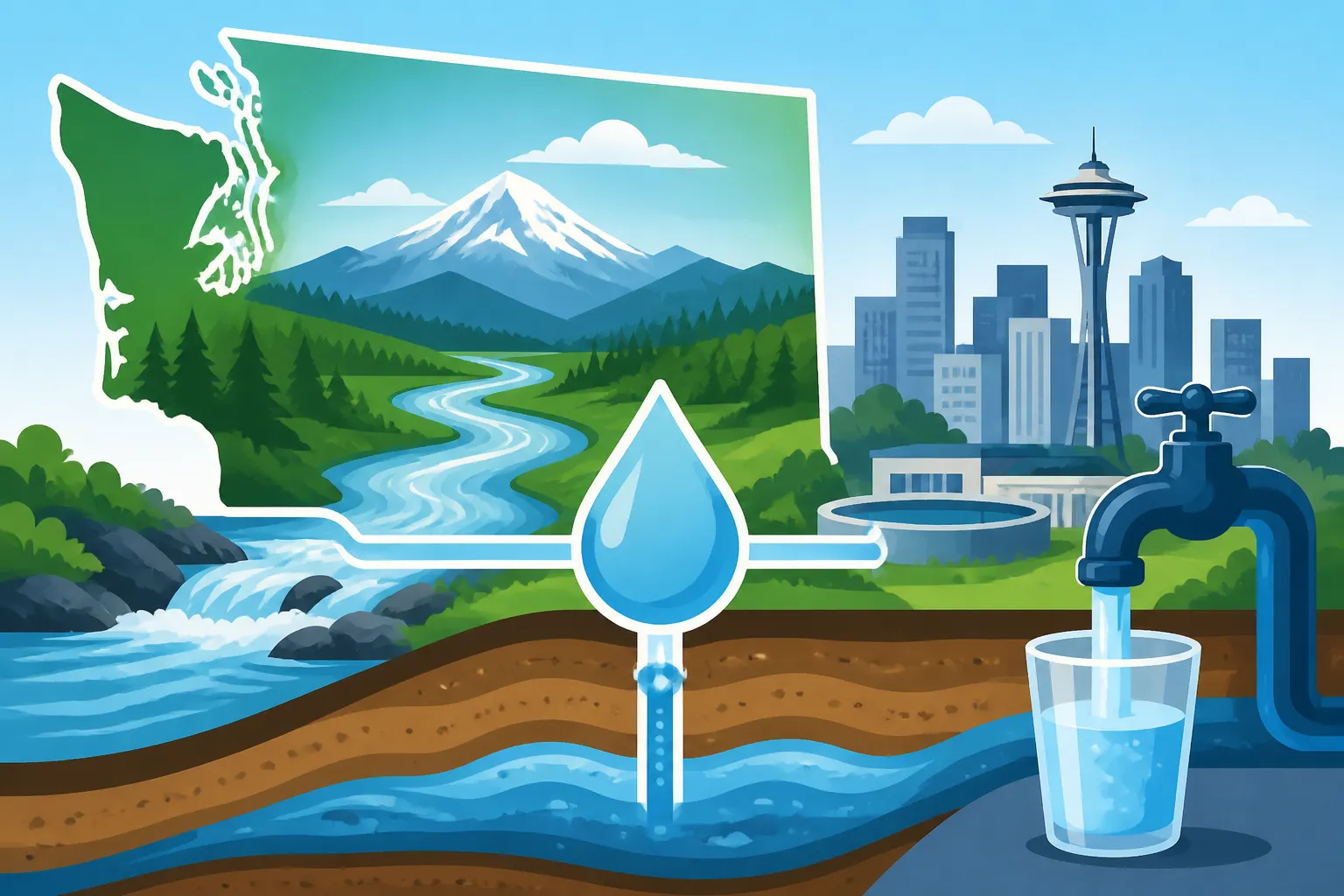
A city’s drinking water generally begins as surface water, groundwater, or a blend of sources. Surface water comes from places such as rivers, lakes, and reservoirs. Groundwater is water held below the land surface in soil and rock formations called aquifers.
Those categories describe where the water originates, not whether it is safe to drink. Public water suppliers treat and monitor water under applicable requirements, but the details vary by system. The water’s source can affect how a supplier manages treatment, what seasonal changes it watches for, and how it plans for a dry period or other disruption.
Surface-water systems draw from a watershed: the area of land where rain and snowmelt drain toward a river, lake, or reservoir. Activities across that area can matter because runoff may carry sediment or other material into the source. A protected watershed can reduce some potential risks, but protection does not mean the water skips treatment or monitoring.
Groundwater systems draw from water stored beneath the ground. An aquifer may extend beyond a city’s boundaries, and a city can use wells to bring that water to the surface. Groundwater often changes differently from surface water, but the label alone does not establish the quality of water at a particular tap. Treatment, well conditions, distribution pipes, and building plumbing all remain relevant.
Some systems use more than one source or can change sources under certain operating conditions. A supplier may use a primary source most of the time and have another source available when demand, maintenance, or other conditions call for it. That makes the source information in a utility’s report more useful than a broad assumption based on the city name alone.
The source is only the beginning of the water’s journey. After collection, water may be treated, stored, and delivered through a network of pipes before reaching a home. Each stage serves a different purpose, and source information should be read alongside the supplier’s water quality information and any current notices.
Examples from Seattle, Bellevue, Spokane and Vancouver
Washington cities illustrate why it is worth checking the source for the provider that actually serves an address. Seattle, Bellevue, Spokane, and Vancouver do not all rely on the same kind of source.
| City | Reported drinking-water source | What the source description tells you |
|---|---|---|
| Seattle | Seattle Public Utilities describes “2 pristine, protected mountain sources: the Cedar River and South Fork Tolt River watersheds.” | Seattle’s supply is associated with protected mountain watersheds and river sources. |
| Bellevue | According to the City of Bellevue, Bellevue’s drinking water comes from the “watersheds of the Tolt and Cedar rivers.” | Bellevue’s stated sources are watersheds that are also part of the source picture described for Seattle. |
| Spokane | According to the City of Spokane, Washington, Spokane’s water comes from the “Spokane Valley-Rathdrum Prairie Aquifer.” | Spokane’s stated source is an aquifer rather than a mountain river watershed. |
| Vancouver | The City of Vancouver, WA, describes its drinking water as “100 percent on groundwater” and says “All of Vancouver’s water comes from groundwater.” | Vancouver’s city supply is described as coming from underground aquifers. |
The table is a starting point, not a substitute for checking the service area. A city name on a mailing address, property listing, or utility bill does not always tell you which organization supplies the water. Boundaries and service areas can differ, and some places receive water from a provider other than the city associated with the address.
Seattle and Bellevue also show why neighboring communities may share aspects of a source region without having identical water systems. The source description helps identify where water originates; it does not mean each city has the same treatment process, storage system, operating practices, or results at every tap. For a closer look at Seattle’s two watersheds, see Cedar or Tolt: Which Mountain Watershed Fills Your Faucet? and Cedar River Watershed vs. South Fork Tolt: How the Two Supplies Differ.
The same caution applies to aquifer-fed cities. Spokane and Vancouver both rely on groundwater, but they do not draw from one shared source simply because both use aquifers. The name of the aquifer or source area is specific to the system described. A groundwater label does not mean that all groundwater has the same mineral content, treatment, or water quality.
For broader context on how water travels from a source to a household, Where Washington Cities Get Their Tap Water, From Rivers to Aquifers is the subject of this article, so a useful next step is to compare the source information with your own provider’s current report rather than infer details from another city’s system.
What a watershed source means for a city
A watershed is a geographic area that drains toward a shared water body. Rain and snowmelt move across land, through soils and streams, and eventually toward a river, lake, or reservoir. For a drinking-water supplier using a watershed, understanding that land area is part of understanding the source.
Watershed protection can help limit activities that might affect the water before it is collected. A supplier may monitor the source, manage access, or work with other parties who have a role in protecting the area. The specific arrangements depend on the location and the organizations involved. “Protected” is useful context, but it is not a guarantee that no contaminants can enter a source or that treatment is unnecessary.
Surface water can change in response to weather and natural conditions. Heavy rain may increase runoff or cloudiness; dry conditions may affect available water or the way a supplier manages its sources. Seasonal changes can also affect taste or odor. Those shifts do not automatically mean the water is unsafe, and a change in taste or appearance cannot by itself identify a contaminant. For practical help interpreting an unusual change, see Taste, Smell and Color of Washington Tap Water, Explained.
A supplier’s treatment process is designed around its source and the water-quality needs it identifies. Treatment may remove particles, disinfect water, or address other source-specific concerns. It is not useful to assume that every surface-water system uses the same process, or that the source description reveals every treatment step. The provider’s report is the place to look for its stated treatment details.
A watershed can also include land beyond a city’s developed area. This is one reason the source name may refer to a river or mountain area rather than the neighborhood where customers live. The water is collected upstream or at another part of the system, treated as needed, and conveyed toward customers. If you want to understand how a particular mountain supply reaches taps, Protected Mountain Watersheds: How River Water Reaches Washington Taps provides more focused context.
Knowing that water comes from a watershed can help you ask better questions: Which river or reservoir supplies the system? Does the provider describe a backup source? What does the annual report say about treatment and monitoring? If a notice is active, does it apply to the source or service area that reaches your address? These are more useful questions than treating “river water” as either automatically safe or automatically concerning.
What an aquifer source means for a city
An aquifer is a subsurface formation that can hold and transmit groundwater. Water may enter an aquifer as precipitation seeps into the ground, though the path and rate depend on local geology and other conditions. A municipal supplier generally accesses groundwater through wells and operates the system that delivers it to customers.
The word “aquifer” does not describe a single, uniform underground reservoir. Aquifers differ in their geology, depth, recharge, and water chemistry. Even wells associated with the same broad aquifer can have differences in the water they produce. The source name is therefore useful for identifying the system’s general origin, but it is not a lab result for a specific home.
Groundwater is sometimes thought of as naturally protected because it is below the land surface. The ground can filter some material as water moves through it, but groundwater can still be affected by natural substances or human activities. A city’s use of an aquifer does not mean the water is untreated or that monitoring is unnecessary. Check the provider’s report for what it tests and how it describes treatment.
Groundwater systems may also have operational needs that differ from surface-water systems. Providers manage wells, pumps, storage, treatment, and connections to the distribution network. Some systems may use several wells or other sources; the details are provider-specific. A city’s source page or water quality report is more dependable than assuming that every customer receives water from one particular well.
Groundwater can have different mineral characteristics from surface water, but source type alone does not reveal whether water is hard or soft. Hardness is a separate water-quality characteristic. If you are weighing a softener or trying to understand scale, use a result for the water that serves your home rather than relying on a general statement about aquifers. Finding Hardness Data for the Water That Actually Serves Your Home explains where to look.
The same distinction applies to contaminants. A water source may have a particular regional context, but it does not establish whether a contaminant is present at a specific concentration. For a household concern, start with the supplier’s results and determine whether a home sample is appropriate. The article Does a Utility Water Report Tell You If Your Own Tap Is Safe? explains why system-wide data and individual plumbing questions are not interchangeable.
From source to faucet: treatment, storage and pipes
Water does not travel directly from a river or aquifer to a kitchen faucet. A public supplier manages the steps between the source and the customer, and the system can include treatment facilities, storage, pumps, and distribution pipes. The specific layout varies by provider.
Treatment is selected to meet the system’s needs. A supplier may need to address particles, microorganisms, or other characteristics of the raw water. Disinfection is one common part of public water treatment, but treatment methods and source conditions differ. The source description alone cannot tell a customer which processes are used or whether a particular household filter is useful.
After treatment, water travels through the distribution system. Storage tanks and reservoirs can help a system manage demand and maintain supply, while pipes convey water through streets and into service connections. The supplier is responsible for operating and monitoring its system, but the final stretch of plumbing inside a building may be owned or maintained by a property owner. That difference matters when a concern may arise from household plumbing rather than the utility’s source.
Water quality can also change after it leaves the treatment plant. Materials in service lines, building pipes, solder, or fixtures can affect water at the tap. A utility report summarizes system monitoring; it does not test every household faucet. For lead-related questions, Lead Service Lines in Washington: An Overview for Residents and A Non-Lead Service Line Doesn’t Clear Your Indoor Pipes and Fixtures explain why the public system and a home’s plumbing need to be considered separately.
This does not mean that a household should automatically buy a filter. A filter is useful only if its stated reduction claim matches the concern and the exact product is certified for that purpose. A filter cannot be selected reliably from the source type alone. Start with the water provider’s report, identify the specific question, and compare any product certification with the results that apply to the home. See Do I Need a Filter for Washington Tap Water? Start With Your Report for a step-by-step way to approach that decision.
If the water changes suddenly in taste, odor, color, or pressure, avoid guessing that the cause is the river or aquifer. A change could be related to work in the distribution system, building plumbing, or another issue. Check whether the provider has issued an alert, ask whether neighbors are affected, and contact the supplier if the problem persists or appears widespread. For immediate concerns, How to Raise a Water Quality Concern With Your Washington Utility covers practical ways to describe what you notice.
How to find the source for your own address
Start by identifying the water provider serving the property, not by assuming that the city name is enough. A home may be inside one city’s postal area but served by another utility or a regional provider. Renters may also receive water through a landlord or building account, so they may not have a utility bill showing the supplier’s name.
A reliable way to get oriented is to use the provider named on a current water bill, ask the landlord or property manager, or use the utility’s official service-area information. If you are unsure which provider serves the address, Find the Water Provider for an Address, Then Find Its Annual Report explains what to check. Renters can also use Where Renters Can Look Up a Building’s Water Supplier when the account is not in their name.
Once you have the provider’s name, look for its annual drinking-water quality report, often called a Consumer Confidence Report or CCR. The report should identify the system and usually describe its water sources, treatment, and monitoring results. The provider’s official website is a sensible place to look for the current report or for information on how customers can request it. Where to Find Your Water Provider’s Latest Test Results in Washington offers a focused route to those records.
When reviewing a report, confirm that it covers the correct water system and reporting period. A provider may operate more than one system, or its public-facing brand may differ from the formal system name used in the report. If the report includes a system name or identification number, use those details to confirm you are reading the right document. System Name or ID: What to Search to Find the Right Water Report covers that distinction.
Then look for the source description. It may name a river, reservoir, watershed, aquifer, or group of wells. Note whether the report describes a primary source, multiple sources, or an emergency or backup source. If the language is unclear, check the provider’s source-water page or ask the provider to explain which source serves the address and whether operations vary.
A source summary is only one part of the report. Check the treatment description and results as well. A detected substance is not automatically a violation, and a system-wide result is not necessarily a measurement from your kitchen faucet. If a result raises a question, find out what it means in the report and whether additional testing is appropriate. Reading a CCR Line by Line: Sources, Detections and Violations can help distinguish those kinds of information.
For homebuyers and renters, keep a copy of the report and note the provider’s contact route for future questions. If the property has a private well rather than a public connection, a city’s tap-water source page will not answer questions about that well. The water source and testing responsibility are different, so use records and testing guidance that apply to the property. For public-system customers who rent, Renting in Washington? Advisory News Without a Utility Account explains ways to stay informed even when utility notices go to someone else.
Sources can vary, and source information has limits
A source description may not capture every operating detail. A provider can have several sources, blend water, or adjust operations. A report may summarize the system’s sources without explaining which one was supplying a particular street at a particular moment. If that distinction matters, ask the supplier rather than trying to infer it from a city map or the name of a nearby river.
Sources and treatment can also be affected by maintenance, demand, or unusual conditions. A utility may use an alternate source or change how it operates its system. Such changes do not, by themselves, mean there is a safety problem. The provider’s notices and current information are the right place to check whether an operational change affects customers. See When a Washington Utility Switches to a Seasonal or Backup Source for more on what a source change can mean.
A city-level source statement also cannot tell you whether a boil-water notice or other advisory applies to your particular address. Notices can cover specific areas or systems. Check the provider’s official alert information and confirm that your address is included before deciding what to do. Does a Washington Boil-Water Notice Cover Your Address? How to Check explains how to verify the area affected.
Source information is not a substitute for a current water quality report. Nor does an old report necessarily represent present operations. Look for the latest report the provider has published, then check whether the source or service conditions have changed since its reporting period. If you want help interpreting older documents, Are Past Years’ Water Quality Reports Still Worth Reading? discusses what past reports can and cannot show.
A utility report also cannot resolve every question about water at a particular faucet. It may describe the system’s monitoring results, while a home’s pipes and fixtures introduce separate considerations. A private test may be appropriate in some situations, but the right test depends on the concern, the sampling location, and the type of system. If you are considering a household sample, How to Test Your Water in Washington: Kits, Labs and Samples explains how to match a test to a question.
There is no need to treat source type as a shortcut for choosing treatment. “River water” does not automatically mean a home needs a filter, and “groundwater” does not automatically mean a home does not. Choose a response based on current information about the provider and, where relevant, the household’s own plumbing or test results. If you have a health concern, ask the local health department or a medical professional rather than relying on source descriptions or product claims.
Frequently Asked Questions
Does Washington have one statewide source for tap water?
No. Public water systems may use surface water, groundwater, or more than one source. The provider’s report is the best starting point for finding the source that applies to a particular service area.
Does groundwater mean a city’s water is untreated?
No. The source type does not tell you whether water is treated. Check the provider’s report for its treatment information and monitoring results.
If two cities use the same river watershed, do they deliver the same water?
Not necessarily. Cities can differ in treatment, operations, distribution systems, and service areas. A shared source description does not establish that water at every tap is identical.
Does a city’s water quality report test my faucet?
Not usually. A report describes monitoring for the water system; it is not a sample from every household. Building plumbing and fixtures may affect water after it enters a property.
Should I buy a filter based on whether my water comes from a river or an aquifer?
No. Source type alone is not enough to choose a filter. Identify the specific concern, check relevant water results, and verify that the exact filter model is certified for the reduction claim you need.
Sources
- City of Spokane, Washington — Our Water Quality – City of Spokane, Washington (checked November 13, 2026)
- City of Vancouver, WA — 2025 Annual Water Quality Report -The City of Vancouver, WA (checked November 13, 2026)
- City of Vancouver, WA — Lead and Drinking Water -The City of Vancouver, WA (checked November 13, 2026)
- City of Bellevue — Water Quality | City of Bellevue (checked November 13, 2026)
Disclaimer
This article is for general informational purposes only and does not constitute professional advice. Laws, prices and regulations vary by location and change over time. Consult a qualified professional for guidance on your specific situation. Washington Water Guide is not a government agency or water utility and is not affiliated with any public water system.